
A small group of islands could lead to a large international dispute.
The Diaoyu Islands in the South China Sea represent a long-lasting dispute between China, Japan, and the United States. Because of their geological and marine resources, strategic location, and historical significance, both China and Japan claim the islands. The United States has also played a role in the dispute in the past and continues to affect the area today. To Japan, the islands are known as the Senkaku Islands, but to China, they’re the Diaoyu Islands, demonstrating the depth of each country’s claim on the islands. This article will provide a full understanding of all the factors involved in the geopolitical conflict.
Why are Japan and China disputing over the Diaoyu Islands?
- Geological and Marine Resources of the Diaoyu Islands
The Diaoyu Islands have a lot of undersea petroleum resources. According to the Cankaoxiaoxi website, in 1966 the United Nations Economic and Social Commission for Asia and the Pacific (ESCAP) concluded that the East China Sea continental shelf was one of the world’s most abundant oil fields. The report suggested that waters near the Diaoyu Islands had the potential to be the “second Middle East.” However, not only are the islands rich in oil, they also hold plentiful fishing resources. Each fishing season, more than 3,000 ships from Fujian and Taiwan provinces fish close to the islands. The annual fishing volume can reach as much as 150,000 tons, reported by the Sohu News.
- Military Strategic Position of the Diaoyu Islands
From the perspective of military geography, the Diaoyu Islands have important military positioning. According to the Sohu News, the Diaoyu Islands could be used by Japan as a bridge or forward base to invade Taiwan, but could also become the outpost of China to defend the East China Sea and curb Japan’s southward expansionary forces.
What is the history and facts of the Diaoyu Islands?

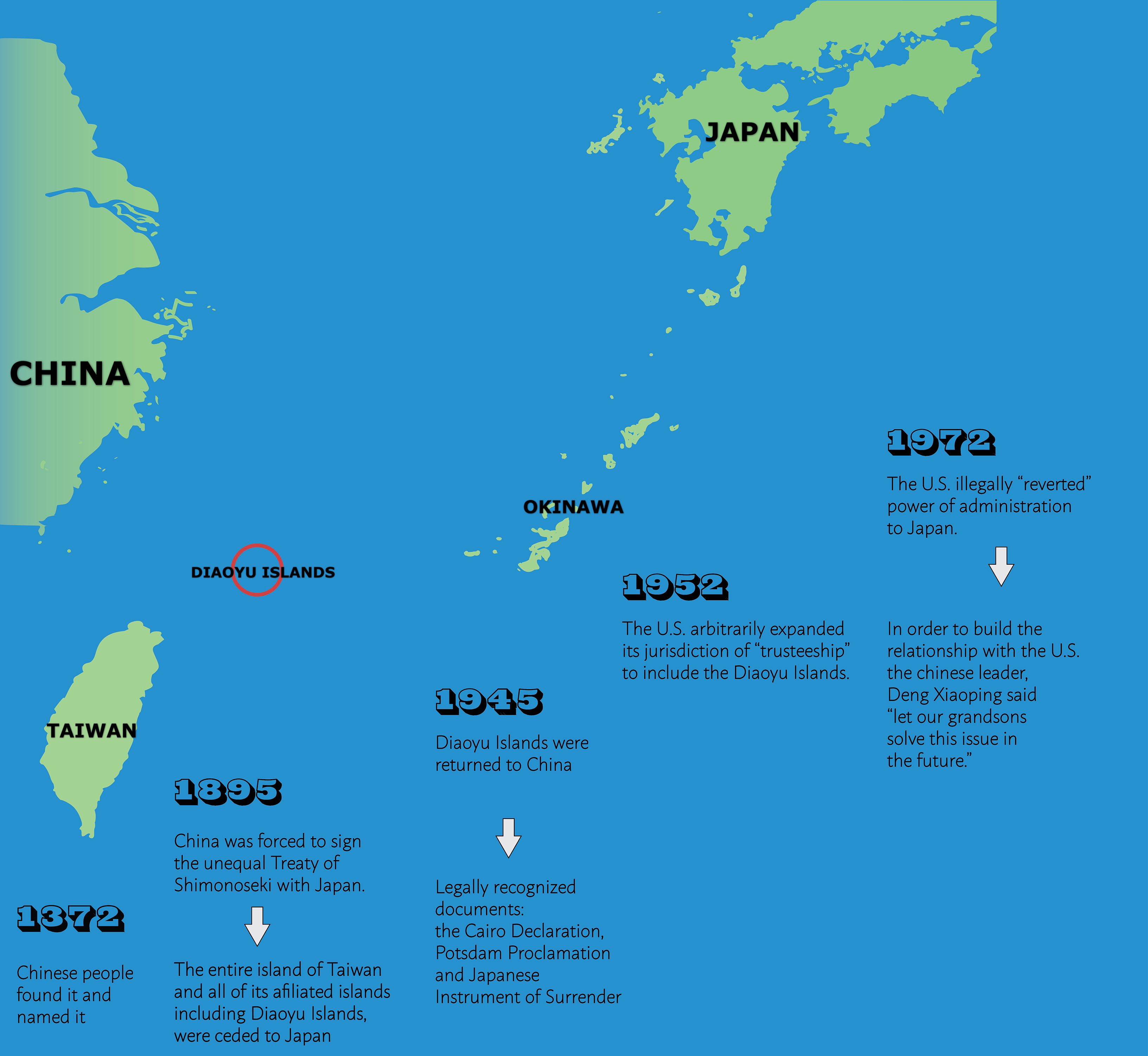
Timeline of the history of the Diaoyu Islands.
Created by Zhongyi Su & Melina Fleury Franco
- The Diaoyu Islands are eight tiny uninhabited islands in the East China Sea.
- They are located 120 nautical miles northeast of Taiwan, 200 miles east of mainland China, and 200 miles southeast of Okinawa, Japan.
- They are separated from Japan by the Okinawa Sea Trough, which is nearly 7,500 feet deep.
Both China and Japan state that the islands belong to them. China created an official website for the Diaoyu Islands. It introduces that Diaoyu Dao and its affiliated Islands (hereinafter referred to as Diaoyu Dao) are an inseparable part of the Chinese territory. Diaoyu Dao is China’s inherent territory in all historical and legal terms, and China enjoys indisputable sovereignty over it. However, The Ministry of Foreign Affairs of Japan introduces that the Senkaku Islands are clearly an inherent part of the territory of Japan, in light of historical facts and based upon international law.
From the beginning of the 1970s, the issue of the sovereignty of the Diaoyu Islands has been the focus of the Sino-Japanese dispute. It gradually developed into a major diplomatic dispute between the two countries when Tokyo Governor Shintaro Ishihara made a speech in April 2012 about the purchase of the Diaoyu Islands. As a world power, the United States, which is allied with Japan, claims that they delivered the “administrative right” of the islands to Japan in 1972 (see above figure.) The speech also highlighted the fact that the U.S. will not choose a side in the dispute. On the other hand, the governor admitted that the US-Japan Security Treaty applies to the disputed islands.
What’s the Chinese media’s view in this issue?
According to the State Oceanic Administration People’s Republic of China, on December 5, 2016, four China Coast Guard boats entered into the waters of the Diaoyu Islands successively in order to finish the regular patrols.As shown below, most Chinese reports describe this incident as a regular patrol and call the islands “our Diaoyu Islands”. This news caused a great response among the Japanese media organizations.
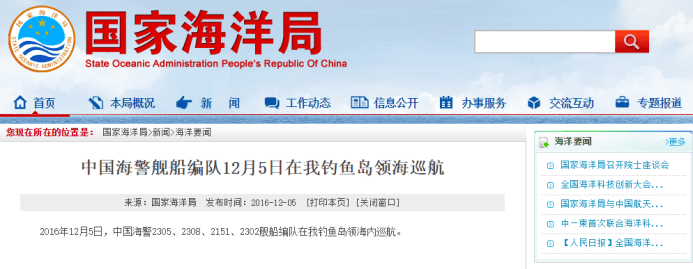
Translated to: China Coast Guard boats conducted a regular patrol in waters surrounding our Diaoyu Islands on December 5.
The Chinese media website, the Huanqiu, uses the word “patrol” in its report headline. It also mentions the Japanese government protested and urged the boats to leave.

Screen-shot of the Chinese media website, the Huanqiu.
Another Chinese news website, the People’s Daily Online, also uses the word “patrol” in its report headline.
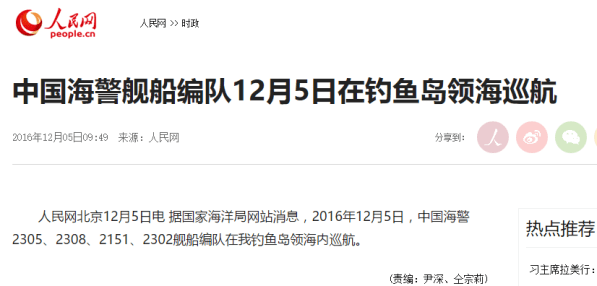
Screen-shot of another Chinese news website, the People’s Daily Online.
Actually, this is not the first time that the China Coast Guard boats patrol in this area. The news list of the State Oceanic Administration shows that China Coast Guard boats patrol the Diaoyu Islands several times per month.

Screen-shot of the news list of the State Oceanic Administration.
What’s the Japanese media’s view in this issue?
According to the NHK, the Japan Coast Guard says four Chinese patrol ships entered Japanese territorial waters of the Senkaku Islands in the East China Sea on December, 5.

The NHK described the Diaoyu Islands as Japanese waters.
Compared to the Chinese media, both the NHK and the Sankei Shimbun use the word “invasion” in their headlines and use the Senkaku Islands refer to the disputed islands. The article from the Sankei Shimbun also counts that this is the 34 times of Chinese ships’ invasions.

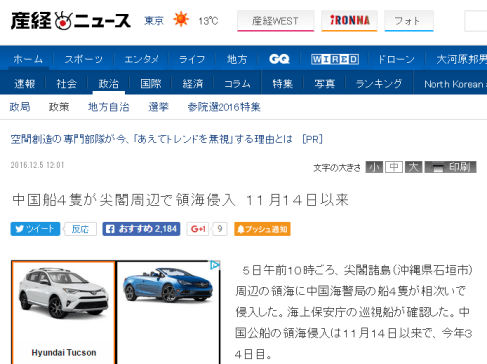
Screen-shots of both the NHK and the Sankei Shimbun.
What’s the American media’s view in this issue?
On January 19, 1960, Japanese Prime Minister Nobusuke Kishi and U.S. Secretary of State Christian Herter signed a historic treaty. It committed the United States to help defend Japan if Japan came under attack, and it provided bases and ports for U.S. armed forces in Japan. On April 24, 2014, according to the CNBC, President Barack Obama offered ally Japan reassuring words, saying that disputed islands in the East China Sea claimed by both Tokyo and Beijing are covered by this U.S.-Japan security treaty.

Sheila Smith, Senior Fellow for Japan Studies at the Council of Foreign Relations, says Obama’s statement on the Senkaku Islands was the most important thing for the Japanese audience.
The Diplomat also reports this news. It uses Senkakus to refer the dispute islands in the headline and mentions the two names of the islands in the blurb.
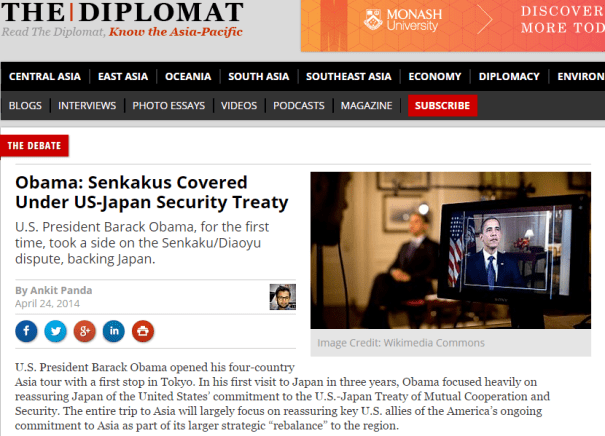
Screen-shot of The Diplomat.
The Washington Post calls the waters near disputed islands “Japanese waters.”

Screen-shot of the Washington Post.
What is the future of this international dispute?
Even now, this dispute is still up in the air. Since the United States is a critical role involved in this issue, President-elect Donald J. Trump’s plan about the relationships with both China and Japan is also influential to the world.
As President-elect Trump says on his official website, peace through strength will be at the center of their foreign policy. They will achieve a stable, peaceful world with less conflict and more common ground. However, whether he will follow this foreign policy or not is still a question.
As the New York Times reports, President-elect Donald J. Trump spoke by telephone with Taiwan’s president, Tsai Ing-wen, on December 2, 2016, a striking break with nearly four decades of diplomatic practice that could precipitate a major rift with China even before Mr. Trump takes office. Later, he told the FOX, “I fully understand the one-China policy, but I don’t know why we have to be bound by the one-China policy unless we make a deal with China.”
Since the United States first opened relations with the communist government on the mainland in 1979, relations between the two powers have been conducted with the understanding that Taiwan was a province of a single China, according to the CNN.
Shalini Venturelli, a professor in the School of International Service, American University, Washington, DC, thinks that President-elect Trump intends to forge strong relationships with China and Japan but within the context of containing escalation of geostrategic rivalry. “He prefers commerce and trade conducted in a fair manner, and strategic rivalry undermines stability and economic development in the U.S. as well as in East Asia,” says Professor Venturelli.
About the future relationship between China and the United States, Christopher Simpson, a professor in the School of Communication, American University, says, “People in China need to understand that Trump is a problem for them. It is not just a trade problem. It is a more complicated problem that has to do with the collision of the big powers.” He thinks that China needs to take into account the extent which this is an unusual circumstance that is unlike other US-China relations all the way back to 1970s.
The Diaoyu Islands conflict will undoubtedly appear in future reports. Public opinion will be an essential part of this issue. Media organizations need to improve and widen their coverage of the issue, as it covers a range of factors. For example, how to comprehensively use the public opinion polling methods to lead the audience to draw their own conclusions through a rational, self-controlled and civilized way.
“Of course it’s media’s responsibility to report all the facts of the disputed islands,” says Su Haihe, a Chinese correspondent from the Economic Daily in the bureau of Tokyo, Japan. “But as for the audience, if they really want to learn about this issue, then they should check the reports from all the relevant sides, both China and Japan, and maybe the United States, too.”

 Zhongyi Su